Children of Incarcerated Parents May Experience Which of the Following
I have the right not to be judged blamed or labeled because my parent is incarcerated. 2When one parent is incarcerated.
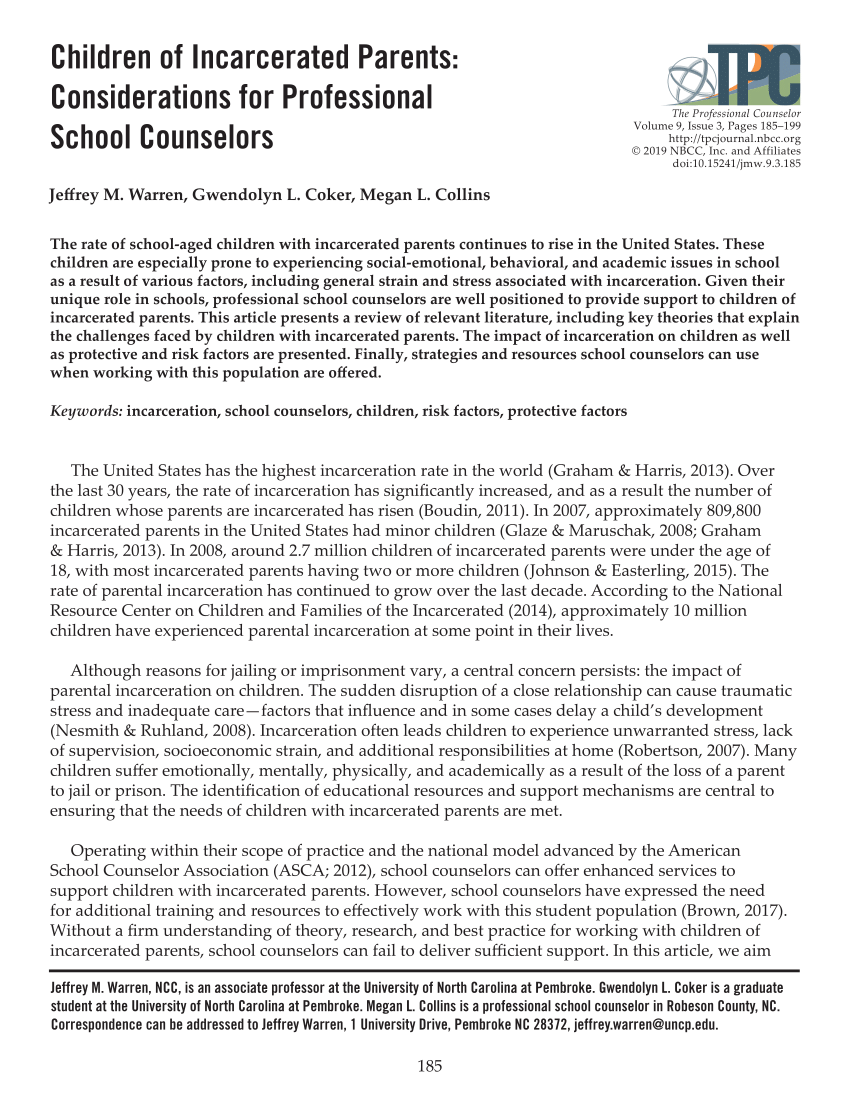
Pdf Children Of Incarcerated Parents Considerations For Professional School Counselors
Siblings may be separated to place in a non-familial care.
. Children of Incarcerated Parents A Bill of Rights 5. Children of incarcerated parents are more likely to share rejection and other adverse childhood experiences Schwartz 1995. COIP also face critical systemic barriers in the areas of education housing mentalphysical health financial hardship and changing caregivers including through the foster care system.
The Impact of Incarceration on Dependent Children. Family members of incarcerated individuals are often referred to as hidden victims victims of the. Create opportunities for children of incarcerated parents to communicate with and support each other.
I have the right to a lifelong relationship with my parent. The following are excerpted from Children of Incarcerated Parents. Aloysius PatrimonioThinkstock see reuse policy.
From emotional and psychological trauma to increased. Children of incarcerated parents face a number of challenges including stigma low expectations and academic performance social and emotional issues and behavioral difficulties. An estimated 27 million children under age 1836 percent of all children had a currently incarcerated parent.
Sudden and often unexpected departure of a parent. Children of incarcerated parents are uniquely impacted by the criminal justice system even when they are not themselves incarcerated. Using data from the 2011-12 National Survey of Childrens Health Murphey and Mae Cooper examine the connections between incarcerated parents and a selection of child well-being indicators such as positive parent-child interaction participation in sports or clubs and school engagement.
There are more than 27 million children of incarcerated parents in the US. Loss of contact between children and their absent parent. From emotional and psychological trauma to increased poverty to being separated permanently from their parents without parent or childs consent mass incarceration devastates many of the children whose parents are.
Children of incarcerated parents COIP are too often on the fringe of the criminal justice reform efforts with their needs underappreciated or deprioritized. And oftentimes that is the case. Substance use family violence divorce and other experiences that may have a negative impact on children.
The struggle that a child of an incarcerated parent experiences in school may go unnoticed by educators leading these children to suffer in silence. Following an opportunity to. I have the right to speak with see and touch my parent.
Parents may be incarcerated in correctional facilities at either the local or state level and. The inability to find work the inability to take care of your family. Children with incarcerated parents specifically Dr.
26 million In 2012 approximately _____ children under the age of 18 had an incarcerated parent in federal or state prison. More likely second parent ishas beenwill be incarcerated. Children with an incarcerated parent may live in high-risk environments and experience a host of consequences from the emotional and psycho- logical trauma of separation increased family disintegration andor dys-.
This brief provides an overview of issues related to children with incarcerated parents and a description of several. Children of the Incarcerated states that three in every hundred American children have a parent behind bars1 When parents are arrested or put in jail or prison their children are often scared confused and upset. Families with incarcerated loved ones also suffer the financial consequences of incarceration.
Children of incarcerated parents face profound and complex threats to their emotional physical educational and financial well-being. Children of incarcerated parents may experience. Representatives from mentoring organizations and other programs with experience serving children with incarcerated parents and their families.
Children who experience parental incarceration are more likely to experience emotional difficulties and problems in school. Children of incarcerated parents face profound and complex threats to their emotional physical educational and financial well-being. Violence dysfunctional households and exposure to drug and alcohol abuse are some of the experiences children of incarcerated parents may experience Schwartz 1995.
This booklet is designed to help moms dads and caregivers answer childrens questions about jail and prison. They are socialized to follow their parents paths. This can have a long-lasting impact on families especially children.
The authors controlled for other factors including divorce exposure. I have the right not to be judged blamed or labeled because my parent is incarcerated. A Bill of Rights.
Many young people take on that pressure fearing that their parents may resort back to the thing that got them locked up in the first place. Reductions in family income. Richards 1992 highlighted the following as significant similarities between childrens experiences of parental divorce and parental incarceration.
And caregivers becoming depressed confused and unable to. Children and Families Incarcerated Parents Children with Incarcerated Parents The differential effects of prison contact on parentchild relationship quality and child behavioral changes The children of prisoners can suffer from behavioral issues poor school performance and heightened risk of crime and delinquency. 1 Children of incarcerated parents experience challenges both unique to parental incarceration and similar to children with other life stressors.
Provide access to specially trained therapists counselors andor mentors. Save five percent for families. The number of incarcerated parents has continued to grow over the past decade and children of color are more likely to experience the incarceration of a parent Graham Harris 2013.
Families are affected through the loss of financial income. Children may be desensitized to criminality and incarceration because. I have the right to support as I face my parents incarceration.
Of children whose parents are incarcerated. In 2007 17 million children in the United States had a parent in prison.

Children Of Incarcerated Parents

Promising And Innovative Practices For Children Of Incarcerated Parents Arrest Through Pre Adjudication Prison Parents Criminal Justice

Parents In Prison And What It S Doing To Children School Social Work Psychoeducation Counseling Psychology


Comments
Post a Comment